


Page 209 - รายงานประจำปี 2568 กรมศุลกากร
P. 209
Tariff Structure


                      The Tariff Structure Section, Customs Tariff Policy and Appeal Division acts as Thailand’s
               representative in negotiations on trade in goods. Currently, there are five (5) Free Trade Agreements
               (FTAs) under negotiation, comprise of:
                      Free Trade Agreements under Negotiation and Concluded Agreements
                      1. Thailand-Peru Free Trade Agreement
                      2. Thailand-European Union Free Trade Agreement
                      3. ASEAN-Canada Free Trade Agreement (ACAFTA)
                      4. Thailand-Republic of Korea Comprehensive Economic Partnership Agreement (KTCEPA)
                      5. ASEAN-India Trade in Goods Agreement (AITIGA)
                      Agreements for which negotiations have been successfully concluded include the Thailand - Bhutan
               Free Trade Agreement, the ASEAN Trade in Goods Agreement (ATIGA), as well as the 29  Meeting of
                                                                                               th
               the Thailand-Malaysia Joint Committee for the Malaysia-Thailand Joint Development Area.
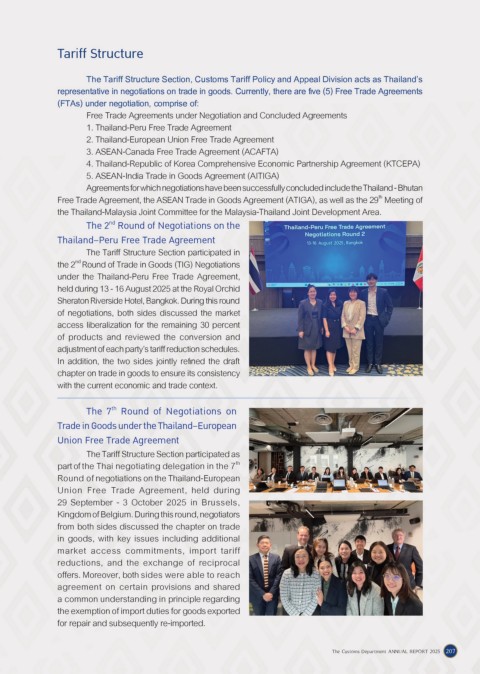
                      The 2  Round of Negotiations on the
                            nd
               Thailand–Peru Free Trade Agreement
                      The Tariff Structure Section participated in
               the 2 Round of Trade in Goods (TIG) Negotiations
                    nd
               under the Thailand-Peru Free Trade Agreement,
               held during 13 - 16 August 2025 at the Royal Orchid
               Sheraton Riverside Hotel, Bangkok. During this round
               of negotiations, both sides discussed the market
               access liberalization for the remaining 30 percent
               of products and reviewed the conversion and
               adjustment of each party’s tariff reduction schedules.
               In addition, the two sides jointly refined the draft
               chapter on trade in goods to ensure its consistency
               with the current economic and trade context.


                             th
                      The 7  Round of Negotiations on
               Trade in Goods under the Thailand–European
               Union Free Trade Agreement
                      The Tariff Structure Section participated as
               part of the Thai negotiating delegation in the 7
                                                           th
               Round of negotiations on the Thailand-European
               Union  Free  Trade Agreement, held during
               29 September - 3 October 2025 in Brussels,
               Kingdom of Belgium. During this round, negotiators
               from both sides discussed the chapter on trade
               in goods, with key issues including additional
               market access commitments, import tariff
               reductions, and the exchange of reciprocal
               offers. Moreover, both sides were able to reach
               agreement on certain provisions and shared
               a common understanding in principle regarding
               the exemption of import duties for goods exported
               for repair and subsequently re-imported.


                                                                                   The Customs Department ANNUAL REPORT 2025  207

