


Page 203 - รายงานประจำปี 2568 กรมศุลกากร
P. 203
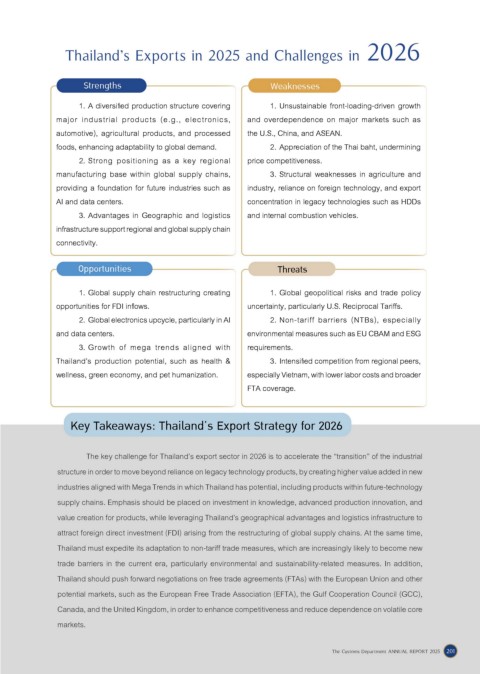
Thailand’s Exports in 2025 and Challenges in 2026


                      Strengths                                     Weaknesses

                     1. A diversified production structure covering       1. Unsustainable front-loading-driven growth
               major  industrial  products  (e.g., electronics,    and overdependence on major markets such as

               automotive), agricultural products, and processed   the U.S., China, and ASEAN.
               foods, enhancing adaptability to global demand.      2. Appreciation of the Thai baht, undermining
                     2. Strong positioning as a key regional    price competitiveness.
               manufacturing base within global supply chains,      3. Structural weaknesses in agriculture and
               providing a foundation for future industries such as   industry, reliance on foreign technology, and export
               AI and data centers.                           concentration in legacy technologies such as HDDs
                     3. Advantages in Geographic and logistics   and internal combustion vehicles.
               infrastructure support regional and global supply chain
               connectivity.


                    Opportunities                                     Threats

                     1. Global supply chain restructuring creating      1. Global geopolitical risks and trade policy
               opportunities for FDI inflows.                 uncertainty, particularly U.S. Reciprocal Tariffs.
                     2. Global electronics upcycle, particularly in AI      2. Non-tariff barriers (NTBs), especially

               and data centers.                              environmental measures such as EU CBAM and ESG
                     3. Growth of mega trends aligned with    requirements.
               Thailand’s production potential, such as health &       3. Intensified competition from regional peers,
               wellness, green economy, and pet humanization.  especially Vietnam, with lower labor costs and broader
                                                              FTA coverage.


                  Key Takeaways: Thailand’s Export Strategy for 2026


                      The key challenge for Thailand’s export sector in 2026 is to accelerate the “transition” of the industrial
               structure in order to move beyond reliance on legacy technology products, by creating higher value added in new
               industries aligned with Mega Trends in which Thailand has potential, including products within future-technology

               supply chains. Emphasis should be placed on investment in knowledge, advanced production innovation, and
               value creation for products, while leveraging Thailand’s geographical advantages and logistics infrastructure to

               attract foreign direct investment (FDI) arising from the restructuring of global supply chains. At the same time,
               Thailand must expedite its adaptation to non-tariff trade measures, which are increasingly likely to become new
               trade barriers in the current era, particularly environmental and sustainability-related measures. In addition,

               Thailand should push forward negotiations on free trade agreements (FTAs) with the European Union and other
               potential markets, such as the European Free Trade Association (EFTA), the Gulf Cooperation Council (GCC),
               Canada, and the United Kingdom, in order to enhance competitiveness and reduce dependence on volatile core

               markets.


                                                                                   The Customs Department ANNUAL REPORT 2025  201

